
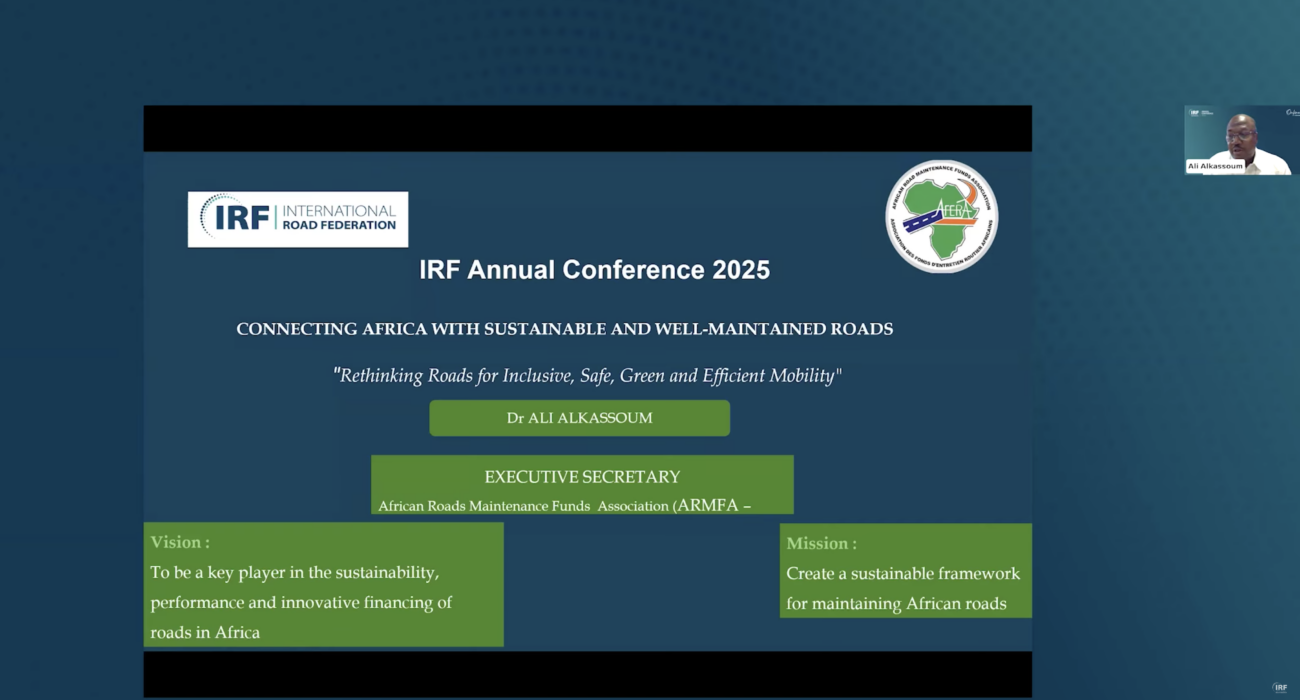
Sustainable infrastructure is not defined by the roads we inaugurate, but by the systems we build to sustain them. This was the central message the African Road Maintenance Funds Association (ARMFA) brought to the Annual Conference of the International Road Federation, held from 2–4 December.
Speaking during the session on Delivering Sustainable Value Chains, Dr. Ali Executive Secretary of ARMFA-AFERA emphasized that sustainability in road infrastructure must be embedded at the earliest stages: in planning, financing, procurement, and design where critical decisions shape long-term carbon footprints, resilience levels, and overall life-cycle value. When sustainability is treated as an afterthought, opportunities for efficiency, emissions reduction, and durability are often lost.
Embedding Sustainability from the Start
From an African perspective, the sustainability of road networks is closely tied to predictable and dedicated financing mechanisms. Without reliable funding streams, even well-designed infrastructure quickly deteriorates, increasing costs and undermining economic growth. The Executive Secretary underscored that strong Road Maintenance Funds, backed by sound governance and digital systems, are essential to preserving assets and ensuring long-term performance.
Maintenance: The Missing Pillar of Sustainability
A key theme highlighted was that maintenance remains the missing pillar of sustainability. While attention often focuses on new construction, it is well-funded, performance-based, and data-driven maintenance that extends asset life, reduces the need for costly rehabilitation, lowers emissions associated with reconstruction, and strengthens climate resilience. Proactive maintenance not only protects investments it safeguards communities, supply chains, and regional connectivity.
Moving Toward Value-Based Procurement
He also stressed the importance of value-based procurement models that go beyond lowest-cost approaches. By aligning procurement decisions with environmental performance, durability, and socio-economic impact, infrastructure delivery can generate long-term returns that far exceed initial cost savings. Integrating green finance instruments, promoting circular materials, and leveraging digital tools for monitoring and transparency were identified as practical pathways toward this goal.
Ultimately, Dr. Alkassoum reinforced a broader call for collaboration. Sustainable road networks cannot be built in isolation they require coordinated action among governments, financiers, technical experts, and regional partners.
Through his participation, he reaffirmed ARMFA-AFERA’s commitment to advancing sustainable road maintenance financing and ensuring that Africa remains an active and influential voice in global infrastructure dialogue. The future of Africa’s roads and the prosperity they enable will not be decreed. It will be built, deliberately and collectively.
ARMFA-AFERA remains steadfast in its commitment to advancing sustainable road maintenance financing and strengthening Africa’s voice in global infrastructure dialogue. Through partnerships, innovation, and evidence-based advocacy, the Association continues to champion resilient, well-managed road networks that support inclusive growth across the continent.
Read more on the: IRF CONFERENCE PAGE
Dr. Ali ALKASSOUM
Executive Secretary: ARMFA-AFERA
ceo@armfa.info